

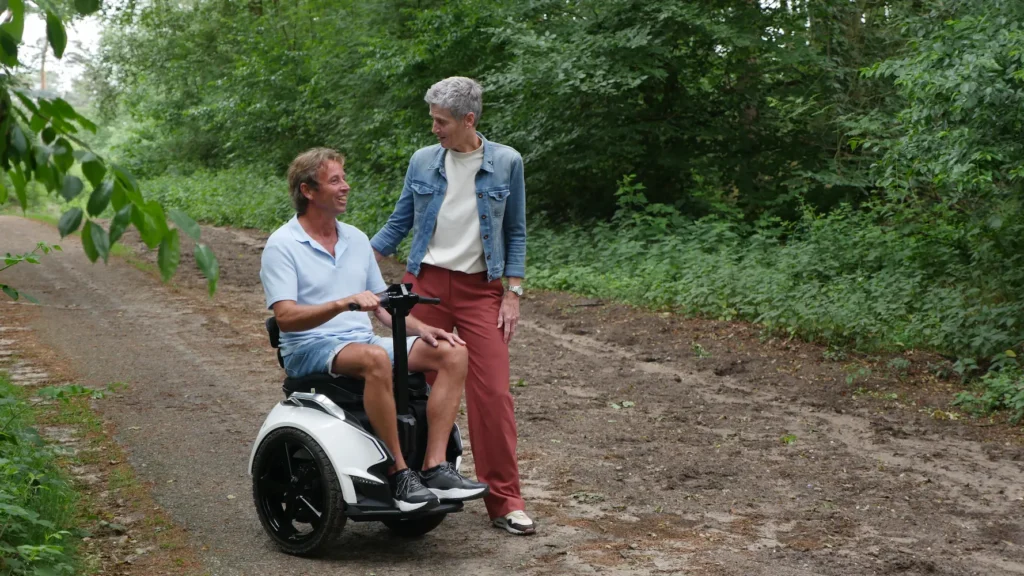
Unpaved paths are tricky: they look “doable” until your wheels sink into loose gravel, your front wheels get caught on tree roots, or every cross-ridge makes you sit more crookedly. You recognize a wheelchair that handles those conditions well by its build and wheel choice, not by a fancy “outdoor” label.
When a wheelchair is truly suitable for unpaved paths
On a forest trail, park route, or semi-paved walking path, you face three problems at once: less grip, more rolling resistance, and more vibrations. A suitable wheelchair solves this with larger wheels, stable geometry, and enough ground clearance so you don’t get “stuck” on every unevenness.
If you mostly ride over short stretches of semi-paved surfaces (shell paths, firm gravel), you can get away with less extreme specifications than if you also encounter potholes, wet patches, or soft sand. In the latter case, it’s wise to look at solutions specifically intended for loose sand; this is explained separately on the page about wheelchairs suitable for sand and shell paths.
What to look for: specifications that make the difference in practice
Wheels: diameter, width, and tread
Large wheels roll more easily over bumps. In practice, you notice this especially with pebbles, roots, and small edges. Width helps prevent sinking, but makes steering heavier and can be less convenient on narrow paths.
- Size: larger (rear) wheels and/or larger front wheels reduce “bouncing” and getting stuck.
- Width: wider tires provide more surface area on loose ground.
- Tread: a coarser tread provides grip on dirt and gravel; a slick tire will slip more easily on wet leaves or loose stones.
Front wheels that don’t dig in
Many problems on unpaved surfaces start at the front. Small casters find every little hole and can “dig in” to gravel or between roots. Larger front wheels (or a front wheel configuration that is less likely to dig in) make the ride smoother and more predictable, especially if someone is pushing you.
Ground clearance and frame geometry
More ground clearance prevents footrests or frame parts from scraping on ridges and bumps. Also pay attention to the length of the wheelbase: a setup that is too compact is agile, but can feel twitchy on bumpy terrain. A more stable geometry often provides more confidence on paths that slope sideways.
Suspension and seating comfort (not luxury, but fatigue management)
Vibrations on semi-paved surfaces take a bigger toll than you might expect. Suspension or damping (in the frame, swingarm, or via tire volume) doesn’t just add comfort; it can also mean you can stay outside longer without pain or cramping. If comfort is your limit, take a look at the explanation on outdoor wheelchair with comfort.
Weight and drive: who pushes, who steers, who brakes
Unpaved terrain requires more power. This applies to self-propelling, but just as much to a companion who is pushing. Heavier wheelchairs can feel stable, but are noticeably harder to move on loose surfaces. Aids such as power assist can be relevant if you often cover longer distances outdoors; that topic is covered more specifically on wheelchairs for long distances outdoors.
Types of wheelchairs you’ll encounter in practice for unpaved terrain
Balance wheelchairs (for those who want to stay active on the path)
A balance wheelchair is not a “standard wheelchair with thicker tires.” The idea is that you ride in balance, which keeps you agile and allows you to approach unevenness differently than in a classic seating position. For unpaved paths, this can be interesting if you like to ride actively yourself and don’t want to be solely dependent on pushing or motor power.
It’s not a match for everyone: riding in balance requires insight, sufficient core strength, and a safe learning progression. When it does fit, it can provide a lot of confidence, especially on paths with bumps and small obstacles. If you want to understand who this type is suitable for first, read what a balance wheelchair is suitable for.
All-terrain (outdoor) manual wheelchairs
These are built around larger wheels, a robust frame, and often more ground clearance. They make sense if you mostly ride with assistance or can do short to medium distances yourself. Don’t expect a “forest feels like asphalt” sensation; you mainly gain stability and fewer instances of getting stuck.
Electric outdoor wheelchairs
Electric power can compensate for a lot: rolling resistance and slight inclines become less of a problem. What you look for shifts: traction (tires), motor power, real-world battery range (cold, soft surfaces), and the width of the wheelchair on narrow paths. If you’re doubting between electric and other solutions, it’s helpful to first get clear on how varied your terrain is; see also wheelchairs for varying surfaces.
Quick check: does your “unpaved” match your wheelchair choice?
Answer this honestly; it will make your choice clear much faster.
- Is the path mostly firm and flat (shells, compact gravel), or loose (gravel, sand, mud)?
- Do you ride yourself, are you usually pushed, or does it vary?
- Is your biggest problem getting stuck, pain from vibrations, or a lack of strength?
- Do you also need to be able to get through narrow gates, bollards, and tight turns?
If bumpiness is your main problem (stones, roots, poor maintenance), then it’s useful to also look at what specifically helps on rough surfaces; this is detailed on wheelchairs for bumpy roads.
Where to go and how to orient yourself without a bad purchase
For unpaved paths, “rolling around the showroom for a bit” is rarely enough. You want to feel what happens on a real path: steering on gravel, braking on a slope, how you feel after ten minutes of bumps. Over de Maes Mobility therefore works by appointment and focuses on balance wheelchairs and active mobility, with time for fitting and explanation. Test drives can often take place on location, specifically to realistically include that unpaved surface.
A good provider will also dare to say if a certain type doesn’t suit your body, route, or way of being outdoors. This prevents you from ending up with a wheelchair that is called “outdoor” on paper, but that you ultimately leave behind because every walk becomes a hassle.
Frequently asked questions about wheelchairs for unpaved paths