

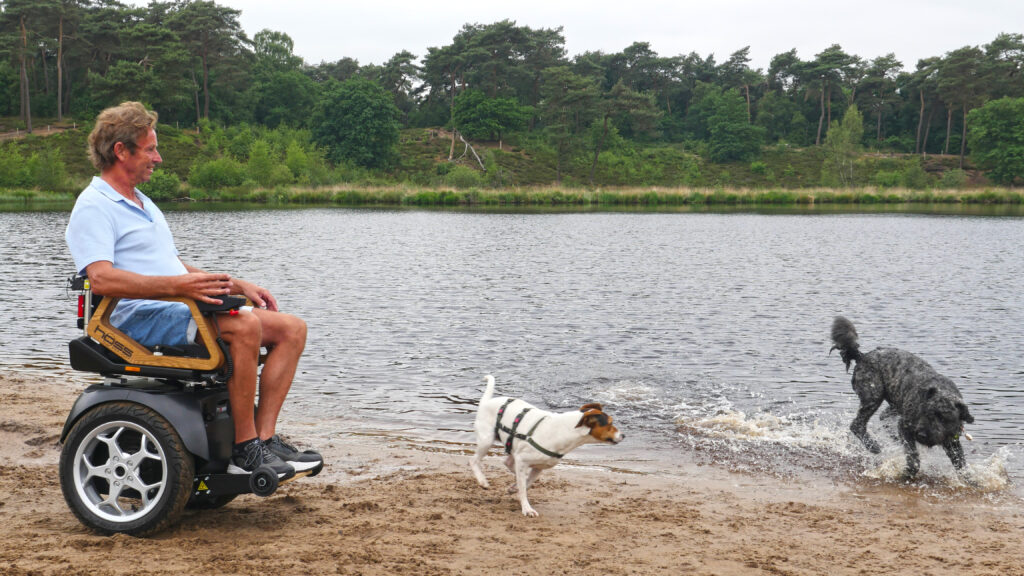
With a standard wheelchair or mobility scooter, you often won’t get very far on the beach. Sand sinks away, shell paths suddenly end, and the transition from boulevard to beach can sometimes be a high threshold. However, there are many places in the Netherlands where you can get onto the beach, usually with a beach wheelchair that you can borrow or rent on-site.
Which beach wheelchairs are available in the Netherlands?
Most Dutch beaches work with one of these three solutions. Which one you encounter depends on the municipality, the beach entrance, and who manages it (pavilion, foundation, municipality, or rescue brigade).
1. Beach wheelchair (manual, “balloon tires”)
This is the classic beach wheelchair with extra-wide tires that don’t immediately sink into the sand. You are usually pushed. Sometimes someone with enough arm strength can move themselves short distances, but in practice, count on having assistance. The advantage: it is available in many places and relatively easy to reserve or pick up.
2. Electric beach wheelchair
At a limited number of locations, you may come across an electric version. This is intended for more independence on the sand and can make the difference if you prefer not to be dependent on being pushed. Supply is smaller, demand is higher, and reservations are more often necessary.
3. Accessible beach route (mat path or shell path)
Sometimes the “wheelchair solution” isn’t the chair, but the route: a sturdy path from the boulevard or parking lot toward a pavilion or a point close to the waterline. This sometimes makes a normal wheelchair or another aid usable, as long as you don’t have to go into the loose sand. In situations where you deal with varying surfaces (path, hard sand, then loose sections again), it’s wise to also look at how your aid performs off the beach. That topic is covered separately on our page about wheelchair use on varying surfaces.
4. Balance wheelchair (for beach routes and varying surfaces)
A balance wheelchair is not a classic beach wheelchair, but it can be a suitable solution in some situations. Especially when you don’t just want to get onto the beach, but also want to drive comfortably over varying surfaces such as boulevards, shell paths, pavers, and firm sand.
Where a manual beach wheelchair is primarily aimed at soft sand and is usually pushed, and an electric beach wheelchair is specifically intended for beach use, a balance wheelchair is more versatile. It can be interesting if you want to remain independent while driving and if the beach visit is part of a larger outdoor use, such as routes along the coast, nature reserves, or recreational paths.
It is important to be realistic about the type of beach and surface. Soft, loose sand remains a challenge for many aids. So it’s not just about whether you can get onto the beach, but also how you get there and what you want to do afterward. In that broader context, a balance wheelchair can be a logical option.
Renting or borrowing: how it usually works
The practice differs per coastal town, but this is the pattern you see most often.
- Via a beach pavilion: you check in at the pavilion, sometimes with a short reservation in advance. The chair often stays “at the pavilion,” meaning you mainly have an accessible terrace and a stretch of beach nearby.
- Via a foundation or lending point: in some seaside resorts, there is a local lending system with fixed opening hours. This can mean: picking up a key, paying a deposit, and returning it before a certain time.
- Via the rescue brigade: at some locations, a beach wheelchair is available under the management of the lifeguards, often primarily focused on safe use in the guarded area.
Things to check beforehand: is a reservation required, what are the opening hours, is assistance needed, and how close to the beach can you get by car to transfer.
How do you find accessible beaches (without gambling upon arrival)?
A beach can be called “accessible” while you still get stuck, simply because your needs are slightly different: you want to drive independently, you need a transfer, or you want to be able to get close to the water.
How to get a more reliable picture beforehand:
- Search for the name of the beach + “beach wheelchair” and see if there is current info from the municipality, pavilion, or a local lending point. Pay attention to the date or season mentioned.
- Check the beach entrance: some places have one suitable entrance and the rest are not. The difference is often in the slope, thresholds, and the type of path.
- Call one specific contact point: a pavilion or a municipal desk can usually tell you in one minute if there is a chair, if you can reserve, and how to get there from parking.
- Ask about the path and where it ends: “to the pavilion” is different from “to right near the waterline.”
Accessibility is more than just the beach wheelchair: this determines if your day is a success
Arranging a beach wheelchair is one thing. Your day often stands or falls with what is arranged around it.
Parking and transferring
A disabled parking space close to the suitable entrance makes a huge difference. If you are making a transfer (from car to wheelchair), you want space next to the car and preferably a flat area. At busy seaside resorts, “nearby” on paper can still mean you first have to navigate a significant route over pavement.
Accessible toilet
Not every pavilion with a wheelchair-accessible terrace also has a truly accessible toilet (turning circle, grab bars, sufficient space). If you want to stay longer, this is often the deciding factor in choosing beach A or B.
Surface around the pavilion
Wooden decking, rubber mats, and wide tiles all drive differently. A small stretch of loose sand between the path and the terrace can already be the difficult part, especially if you are alone or if your companion doesn’t have much strength.
When is a beach wheelchair enough, and when do you want something else?
A beach wheelchair (borrowing/renting) works best if you are planning a day at the beach at a spot with a clear path, a lending point, and a pavilion nearby. You usually accept that you need help with pushing or maneuvering in loose sand.
Do you want to go out more often, including off the beach, or do you want an aid that you take with you on holidays and day trips (with diverse paths and surfaces)? Then it makes sense to look broader than just “something for the beach.” This is covered in more detail on our page about wheelchair use for holidays and day trips.
Practical: three questions to ask beforehand (to avoid 90% of disappointments)
- Is there a beach wheelchair available, and do I need to reserve?
- How do I get from the parking spot to the beach: is there a mat path/wheelchair path, and where does it lead?
- Is there an accessible toilet near the point where I arrive?
With those answers, you’ll quickly know if a beach is feasible by borrowing/renting on-site, or if you’re better off choosing another location.
Frequently asked questions about accessible beaches in the Netherlands
What types of beach wheelchairs are available in the Netherlands?
In the Netherlands, there are mainly three types of beach wheelchairs available: manual beach wheelchairs with balloon tires, electric beach wheelchairs, and accessible beach routes with mat or shell paths.
How can I rent or borrow a beach wheelchair?
A beach wheelchair can usually be rented or borrowed via a beach pavilion, a local foundation, or a rescue brigade. The process can differ per location, but generally, you check in at the pavilion or lending point and may pay a deposit.
What should I check before going to an accessible beach?
Check if a beach wheelchair is available and if a reservation is needed, the accessibility of the path from the parking lot to the beach, and if there is an accessible toilet nearby.
What are the advantages of an electric beach wheelchair?
An electric beach wheelchair offers more independence on the sand than a manual wheelchair, so users are not dependent on others to move around. However, supply is more limited and reservations may be necessary.