

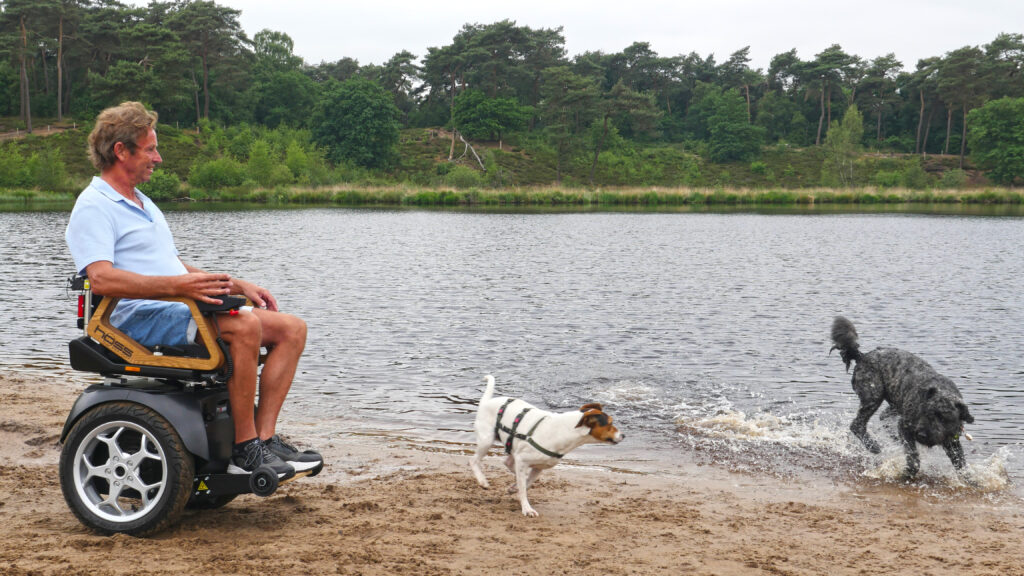
Applying for a PGB for a (balance) wheelchair: a practical and strategic step-by-step plan
Applying for a Personal Budget (PGB) for a wheelchair through the municipality can give you a lot of freedom to decide for yourself which (balance) wheelchair best suits your situation. With a PGB, you are the client for your own assistive device, such as a balance wheelchair and any services (like maintenance), instead of the municipality arranging that directly for you.
- Orient yourself thoroughly
Before you start the application, it is important to first explore exactly what you need. Talk to different suppliers, visit events where balance wheelchairs are presented, such as the Veinedagen (Utrecht) or Rehacare (Dusseldorf), and ask an occupational therapist for advice. They can help determine your specific requirements. Additionally, an independent client supporter from the municipality can help you better understand the process. At Over de Maes Mobility, we can also support you throughout the entire process.
- Describe your situation clearly
It helps to prepare a document in advance in which you clearly explain your daily life, needs, and why you want to use a specific balance wheelchair. This doesn’t have to be an official requirement, but it creates clarity for both yourself and the municipality. Try to use terms like participation and independence; these align well with the criteria of the Social Support Act (Wmo).
- Create a list of requirements
Make a list of technical and functional requirements that your ideal (balance) wheelchair must have: think of seat height, adjustment options, range (for electric models), comfort, and any special functions. Ideally, have this drawn up or supported by an occupational therapist; this gives your application extra weight because it makes it clear why a standard wheelchair is insufficient.
- Explicitly state your PGB preference
When you submit an application to the Wmo desk (this can be done by phone or online at your municipality), clearly state that you are choosing a PGB instead of care in kind. During the “kitchen table conversation” with a Wmo consultant, you can explain why a standard provision is not sufficient and why a PGB is the best option for you.
- Gather a strong quote
The first meeting is often followed by a fitting, where a supplier looks at which type of wheelchair is suitable. At the request of the customer, we at Over de Maes Mobility have been present for this on several occasions. Request a detailed quote that describes not only the chair itself, but also matters such as maintenance and any future adjustments. Sometimes the municipality asks for multiple quotes; make sure you have prepared this well.
- Respond quickly to documents
When the municipality processes your application, you will receive a report and a proposal. Check if everything matches what you discussed. If it meets your wishes, agree to it and send it back promptly (for example, with a photo of your signature via email) to prevent unnecessary delays.
- Stay persistent
Be prepared for the fact that the process doesn’t always go smoothly. Questions may arise, or additional information may be requested. Persistence and good documentation increase the chance that your PGB application will be granted.
- Think ahead
A PGB is often granted for a period of several years. When applying, think about how your situation might develop in the coming years; a progressive condition may require different considerations than a more stable situation.
Why you choose a PGB
With a personal budget, you decide for yourself which wheelchair you purchase, which supplier you choose, and how you arrange maintenance. This gives you more control and flexibility than a standard Wmo provision, but it also requires you to manage and substantiate the process well (either yourself or with our help).